feat(mobile): allow selecting and copying message text - #6166
Conversation


Signed-off-by: liferidge <liferidge66@gmail.com>
57ee4ec to
f97872c
Compare

|
We reviewed this from the Using A few package-specific notes:
The PR’s selection-state provider, disabled long-press interceptor, and explicit Done control are all consistent with the renderer’s selection model. |

…message-text

Signed-off-by: liferidge <liferidge66@gmail.com>

# Conflicts:
#	mobile/test/features/channels/channel_detail_page_test.dart
|
Thanks — we'll keep SelectionArea at MessageContent, keep copy-all / code-block copy, and include lists, tables, images, and code-block chrome in the manual test plan. Noted on the 1.1.6 → newer gpt_markdown imageBuilder width/height change. |


## Summary Inline code on mobile renders as **bold body text on a faint background wash** — no monospace face, no chip, and it cannot wrap. #5257 diagnosed this as a missing `highlightBuilder`. That is no longer the right fix. `gpt_markdown` 1.2.0 deprecates `highlightBuilder` (removal in 2.0.0), renders inline code as a real chip, and adds `InlineCodeStyle` for restyling it. The package author confirmed this on the issue. So this PR is an upgrade — 1.1.6 → 1.2.1 — plus one theme declaration, rather than the builder the issue originally asked for. **Where the style is declared.** `GptMarkdownThemeData` goes in `AppTheme._buildTheme`, which both `light()` and `dark()` call. That reaches all four `GptMarkdown` call sites — `message_content`, `transcript_item_widget`, `token_pill`, `custom_emoji_render` — so the style is stated once instead of per widget. A widget-level `inlineCodeStyle` would have covered channel messages only, leaving the other three on the package's defaults. **What is declared.** Face, size, ink, chip fill and outline — not the face alone. A face name on its own leaves the rest on the package's defaults, which put inline code at 14.1sp beside a fenced block's 13, on a neutral `onSurface` tint rather than the app's code surface. In dark that tint is *lighter* than the surface, while every other code surface in the app is recessed, so the chip read as a different kind of object. All of it now comes from one `CodeStyle` declaration that the fenced block reads from too, so the two cannot be edited apart. **Three adaptations the upgrade requires.** Each was found by running the gate, not by reading the changelog: 1. **`imageBuilder` widened** to `(context, url, width, height)`. This is a hard compile error, and it is **not listed in the package's migration guide**, which states "nothing here stops code compiling". Worth reporting upstream. 2. **`autolink` now defaults to `true`.** `normalizeBareLinks()` already rewrites bare URLs into Markdown links before rendering, so both would run. `message_content` opts out with `autolink: false` to keep current behaviour exactly. The migration guide argues for dropping the pre-processor instead — a better fix, but a behavioural change that belongs in its own PR. 3. **`gpt_markdown.dart` now re-exports `markdown_config.dart`**, making two direct imports redundant. `flutter analyze` reports `No issues found!` on 1.1.6 and flags both on 1.2.1, so these warnings are new, not pre-existing. **Deliberately out of scope.** The three non-message call sites now autolink bare URLs, since only `message_content` has a pre-processor to collide with. Custom inline components (`_MentionMd`, `CustomEmojiMd`, `_ChannelLinkMd`) could additionally declare `allScopesExceptLinkLabel` — 1.2.0 offers it as the fix for a `WidgetSpan` chip going blank inside a link label on iOS — but current behaviour is unchanged without it, so that stays a separate change. ### Related issue Fixes #5257 Duplicate scan: searched `gpt_markdown`, `inline code mobile`, `highlightBuilder` and `InlineCodeStyle` across both PRs and issues. No open PR touches inline code styling. #6135 (link labels) and #6166 (text selection) also touch mobile Markdown but address different defects. ### Testing Full gate, `just ci` — exit 0: | Stage | Result | |---|---| | Rust (33 suites) | 4768 passed, 0 failed | | Desktop | 5799 passed, 0 failed | | Mobile | **2011 passed**, 0 failed | | `flutter analyze` | `No issues found!` | | Desktop + web build | ok | Run on the branch with `main` merged in, so these numbers match what CI builds. **New regression test** — `renders inline code in the app code style`. It resolves the `CodeTextSpan` the package tags inline code with, which carries both the resolved `TextStyle` and the colours the chip behind it is painted with, so face, size, ink, fill and outline are all asserted rather than a widget's presence. It is negative-controlled: reverting only the theme declaration fails it with ```text Expected: a numeric value within <0.001> of <13.0> Actual: <14.1> ``` and dropping the declaration entirely falls back to `packages/gpt_markdown/JetBrainsMono` — so the test measures the real thing, and it would catch a future regression that silently drops the theme extension. The test passes `baseStyle: messageBodyTextStyle`, the style the message surfaces actually use; the widget's own fallback is the smaller `bodyMedium`, which would move the expected size. The test finds paragraphs with `find.byWidgetPredicate((widget) => widget is RichText)`, not `find.byType(RichText)`: inline code renders through `BidiRichText`, a `RichText` subclass, and `byType` matches exact runtime types. That is a hazard for any test that reads text back out of a paragraph, and one landed after this branch was cut: `message_content_custom_emoji_test.dart` arrived with #6996 and its `code keeps literal emoji while adjacent known tokens render` case reads a code span through `find.byType(RichText)`. It passes on `main` and fails on the merge result, which is what CI builds, so it went red only once CI was authorized. It now uses the same predicate. The two other `byType(RichText)` call sites — the rest of that file and `message_author_meta_test.dart` — were re-run and pass: their content carries no code span, so the exact type still matches. They were left alone. ### Screenshots Rendered through the real `MessageContent` widget with the app's own fonts loaded, at 390pt wide, 3x DPR. Sample text: ``Set `BUZZ_RELAY_URL` before launch, then run `just mobile-test` to verify.`` | | Before (1.1.6) | After (1.2.1) | |---|---|---| | Light | 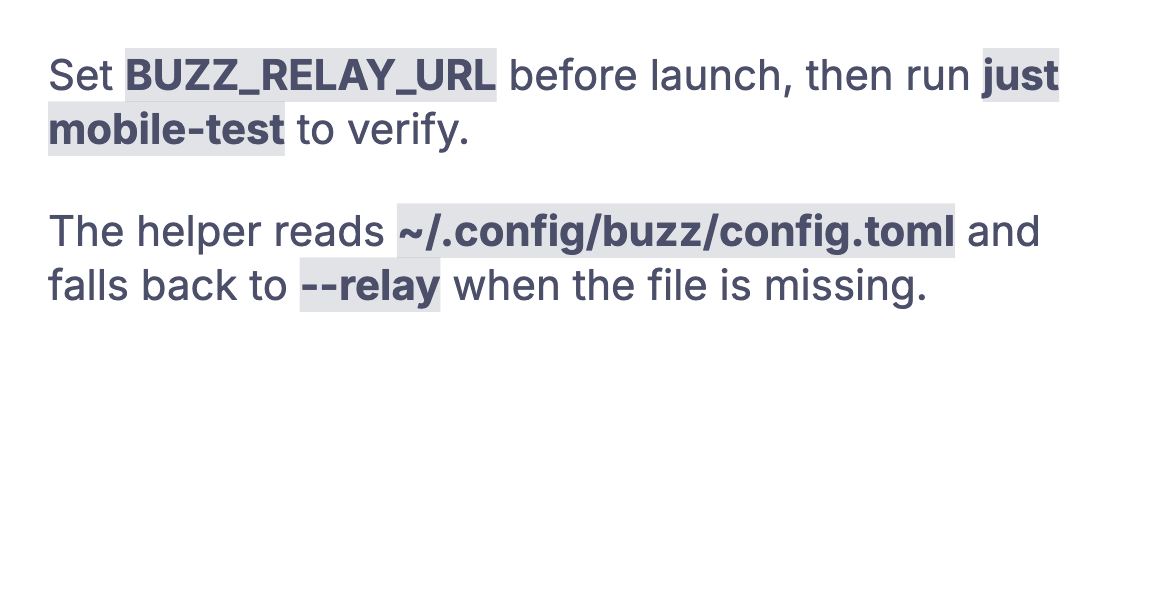 | 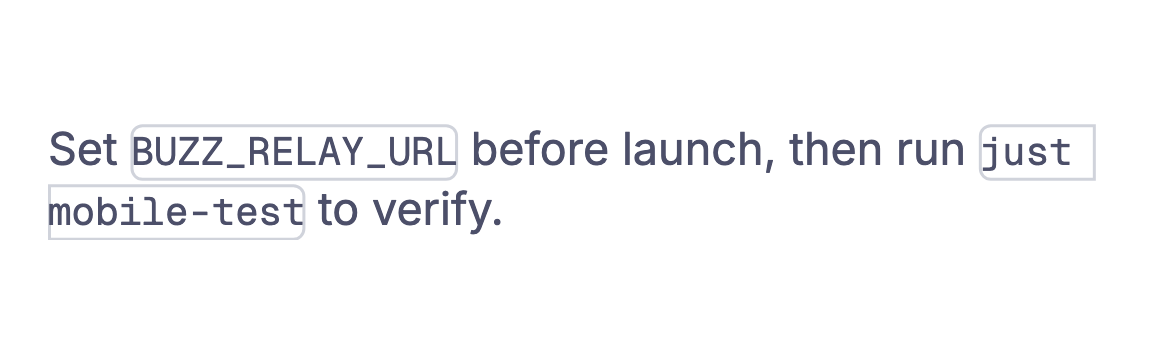 | | Dark | 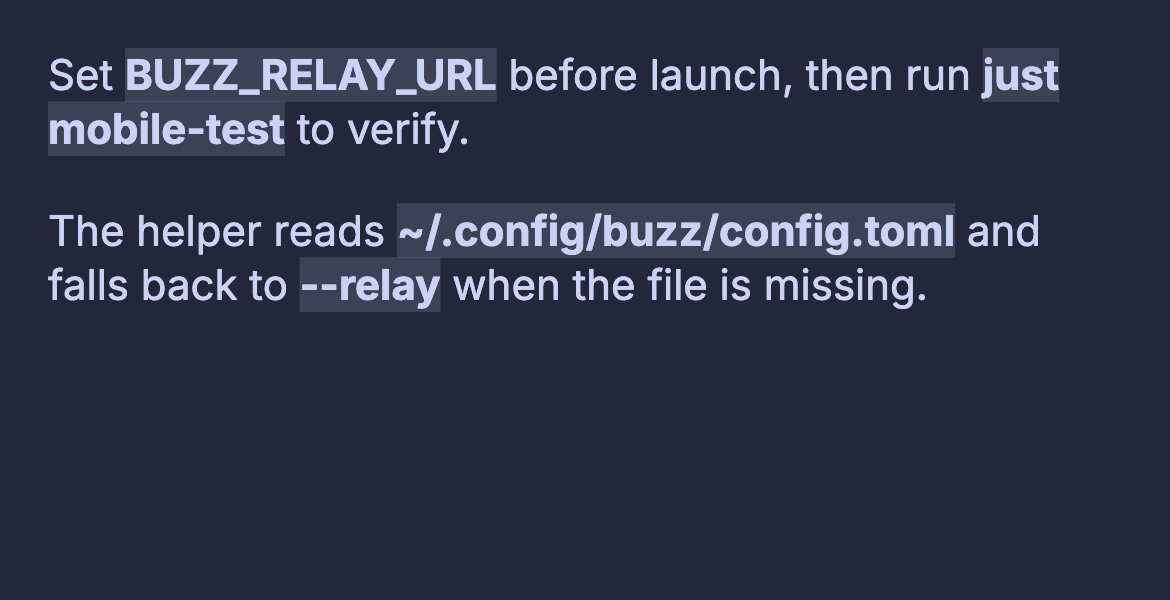 | 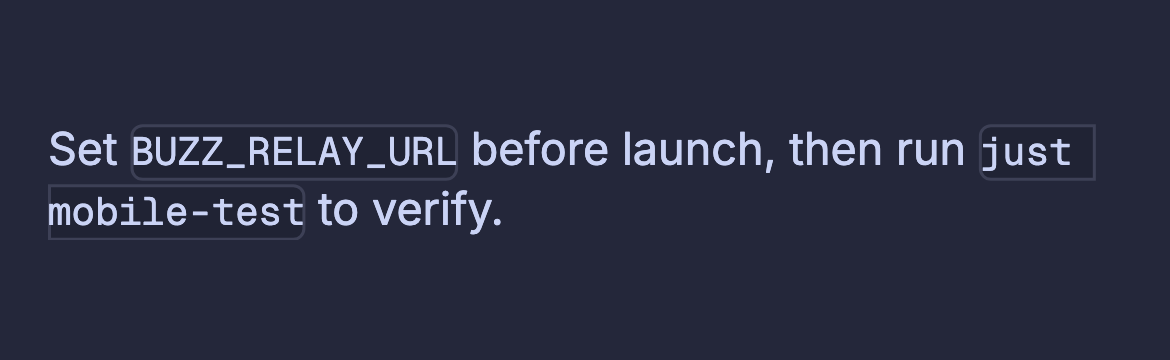 | Before: bold Inter on a flat wash, no chip edge, and `just mobile-test` breaks across the line with the wash simply ending. After: Geist Mono in a bordered, rounded chip, and the wrapped fragment gets its own chip on each line. --------- Signed-off-by: Tolga Cinisli <tolgacinisli@gmail.com> Co-authored-by: Tolga Cinisli <tolgacinisli@gmail.com>
…message-text

Signed-off-by: liferidge <liferidge66@gmail.com>

🔐 Codex Security Review
|






* fix(mobile): style inline code with the app mono face (block#6631) ## Summary Inline code on mobile renders as **bold body text on a faint background wash** — no monospace face, no chip, and it cannot wrap. block#5257 diagnosed this as a missing `highlightBuilder`. That is no longer the right fix. `gpt_markdown` 1.2.0 deprecates `highlightBuilder` (removal in 2.0.0), renders inline code as a real chip, and adds `InlineCodeStyle` for restyling it. The package author confirmed this on the issue. So this PR is an upgrade — 1.1.6 → 1.2.1 — plus one theme declaration, rather than the builder the issue originally asked for. **Where the style is declared.** `GptMarkdownThemeData` goes in `AppTheme._buildTheme`, which both `light()` and `dark()` call. That reaches all four `GptMarkdown` call sites — `message_content`, `transcript_item_widget`, `token_pill`, `custom_emoji_render` — so the style is stated once instead of per widget. A widget-level `inlineCodeStyle` would have covered channel messages only, leaving the other three on the package's defaults. **What is declared.** Face, size, ink, chip fill and outline — not the face alone. A face name on its own leaves the rest on the package's defaults, which put inline code at 14.1sp beside a fenced block's 13, on a neutral `onSurface` tint rather than the app's code surface. In dark that tint is *lighter* than the surface, while every other code surface in the app is recessed, so the chip read as a different kind of object. All of it now comes from one `CodeStyle` declaration that the fenced block reads from too, so the two cannot be edited apart. **Three adaptations the upgrade requires.** Each was found by running the gate, not by reading the changelog: 1. **`imageBuilder` widened** to `(context, url, width, height)`. This is a hard compile error, and it is **not listed in the package's migration guide**, which states "nothing here stops code compiling". Worth reporting upstream. 2. **`autolink` now defaults to `true`.** `normalizeBareLinks()` already rewrites bare URLs into Markdown links before rendering, so both would run. `message_content` opts out with `autolink: false` to keep current behaviour exactly. The migration guide argues for dropping the pre-processor instead — a better fix, but a behavioural change that belongs in its own PR. 3. **`gpt_markdown.dart` now re-exports `markdown_config.dart`**, making two direct imports redundant. `flutter analyze` reports `No issues found!` on 1.1.6 and flags both on 1.2.1, so these warnings are new, not pre-existing. **Deliberately out of scope.** The three non-message call sites now autolink bare URLs, since only `message_content` has a pre-processor to collide with. Custom inline components (`_MentionMd`, `CustomEmojiMd`, `_ChannelLinkMd`) could additionally declare `allScopesExceptLinkLabel` — 1.2.0 offers it as the fix for a `WidgetSpan` chip going blank inside a link label on iOS — but current behaviour is unchanged without it, so that stays a separate change. ### Related issue Fixes block#5257 Duplicate scan: searched `gpt_markdown`, `inline code mobile`, `highlightBuilder` and `InlineCodeStyle` across both PRs and issues. No open PR touches inline code styling. block#6135 (link labels) and block#6166 (text selection) also touch mobile Markdown but address different defects. ### Testing Full gate, `just ci` — exit 0: | Stage | Result | |---|---| | Rust (33 suites) | 4768 passed, 0 failed | | Desktop | 5799 passed, 0 failed | | Mobile | **2011 passed**, 0 failed | | `flutter analyze` | `No issues found!` | | Desktop + web build | ok | Run on the branch with `main` merged in, so these numbers match what CI builds. **New regression test** — `renders inline code in the app code style`. It resolves the `CodeTextSpan` the package tags inline code with, which carries both the resolved `TextStyle` and the colours the chip behind it is painted with, so face, size, ink, fill and outline are all asserted rather than a widget's presence. It is negative-controlled: reverting only the theme declaration fails it with ```text Expected: a numeric value within <0.001> of <13.0> Actual: <14.1> ``` and dropping the declaration entirely falls back to `packages/gpt_markdown/JetBrainsMono` — so the test measures the real thing, and it would catch a future regression that silently drops the theme extension. The test passes `baseStyle: messageBodyTextStyle`, the style the message surfaces actually use; the widget's own fallback is the smaller `bodyMedium`, which would move the expected size. The test finds paragraphs with `find.byWidgetPredicate((widget) => widget is RichText)`, not `find.byType(RichText)`: inline code renders through `BidiRichText`, a `RichText` subclass, and `byType` matches exact runtime types. That is a hazard for any test that reads text back out of a paragraph, and one landed after this branch was cut: `message_content_custom_emoji_test.dart` arrived with block#6996 and its `code keeps literal emoji while adjacent known tokens render` case reads a code span through `find.byType(RichText)`. It passes on `main` and fails on the merge result, which is what CI builds, so it went red only once CI was authorized. It now uses the same predicate. The two other `byType(RichText)` call sites — the rest of that file and `message_author_meta_test.dart` — were re-run and pass: their content carries no code span, so the exact type still matches. They were left alone. ### Screenshots Rendered through the real `MessageContent` widget with the app's own fonts loaded, at 390pt wide, 3x DPR. Sample text: ``Set `BUZZ_RELAY_URL` before launch, then run `just mobile-test` to verify.`` | | Before (1.1.6) | After (1.2.1) | |---|---|---| | Light |  |  | | Dark |  |  | Before: bold Inter on a flat wash, no chip edge, and `just mobile-test` breaks across the line with the wash simply ending. After: Geist Mono in a bordered, rounded chip, and the wrapped fragment gets its own chip on each line. --------- Signed-off-by: Tolga Cinisli <tolgacinisli@gmail.com> Co-authored-by: Tolga Cinisli <tolgacinisli@gmail.com> * fix(buzz-acp): wake held ACP threads and fence forked sessions (block#7340) ## Summary Adds an independent deadline wakeup so held thread work dispatches after its 10-second bound even when the relay loop is otherwise quiet. Fences session ownership by generation so a worker returning after a fork cannot make an older provider session claimable again. This follows up on the two post-merge findings from [block#7337](block#7337 (review)). ### Related issue Follow-up to block#7337. ### Testing - `cargo test -p buzz-acp` - `cargo clippy -p buzz-acp --all-targets -- -D warnings` - Pre-push file-size, differential Rust test, and desktop Tauri gates No UI changes. --- **Update Sep 4, 15:35:** Addressed both Codex review findings. - Queue-cap eviction now prunes orphaned hold deadlines. - An expired hold stays expired until a worker is successfully claimed. - Hold timers remain disabled while every worker is busy; worker return wakes dispatch directly. - Added regressions for queue eviction and pool exhaustion. Generated with Codex --------- Signed-off-by: Salman Mohammed <smohammed@squareup.com> --------- Signed-off-by: Tolga Cinisli <tolgacinisli@gmail.com> Signed-off-by: Salman Mohammed <smohammed@squareup.com> Co-authored-by: TolgaCinisli <tolga.cinisli@photier.com> Co-authored-by: Tolga Cinisli <tolgacinisli@gmail.com> Co-authored-by: Salman Mohammed <smohammed@squareup.com>
2 participants


Problem
On the mobile client, users cannot highlight a portion of a message and copy just that substring. Long-press opens the action sheet and Copy text puts the entire
message.contenton the clipboard. That is fine for a short line, not for grabbing a URL, a command, or a quote out of a longer message.Tracking: #6165
Approach
Keep the existing long-press action sheet (including Copy text). Add a Select text row that pops the sheet and puts that message/post into a selection mode:
StateProvider<String?>(messageTextSelectionIdProvider) tracks the id currently selecting.SelectionAreaso the platform selection handles / Copy menu work.GptMarkdown(selectable: true)is not used: gpt_markdown 1.1.6 (seepubspec.lock) has noselectableparameter. Selection isSelectionAreaonly.MessageLongPressInkWell.enabledis set tofalsefor that row so the pointer interceptor no longer cancels long-press/drag.Taps on links, mentions, channel chips, media, and reactions are unchanged when not in selection mode. Code-block copy-all is unchanged.
How to test
Automated (from
mobile/):Manual (iOS and Android):
I could not attach simulator screenshots in this environment.
Related
None found for this exact mobile message-body selection gap. Closest open issues:
Fixes #6165